Key Takeaways
- HeyGen vs Synthesia comparisons that focus only on features miss the real decision driver: total cost of ownership over 12 months, which ranges from $7,500 to over $25,000 for a 25-person team depending on platform and usage.
- Neither platform has published HIPAA compliance documentation as of March 2026, despite growing search demand from healthcare and financial services buyers.
- Both platforms now offer SCORM export and interactivity on higher tiers, but only as add-ons to a video-first workflow. Neither provides the full content lifecycle (document to course to LMS) that training teams need.
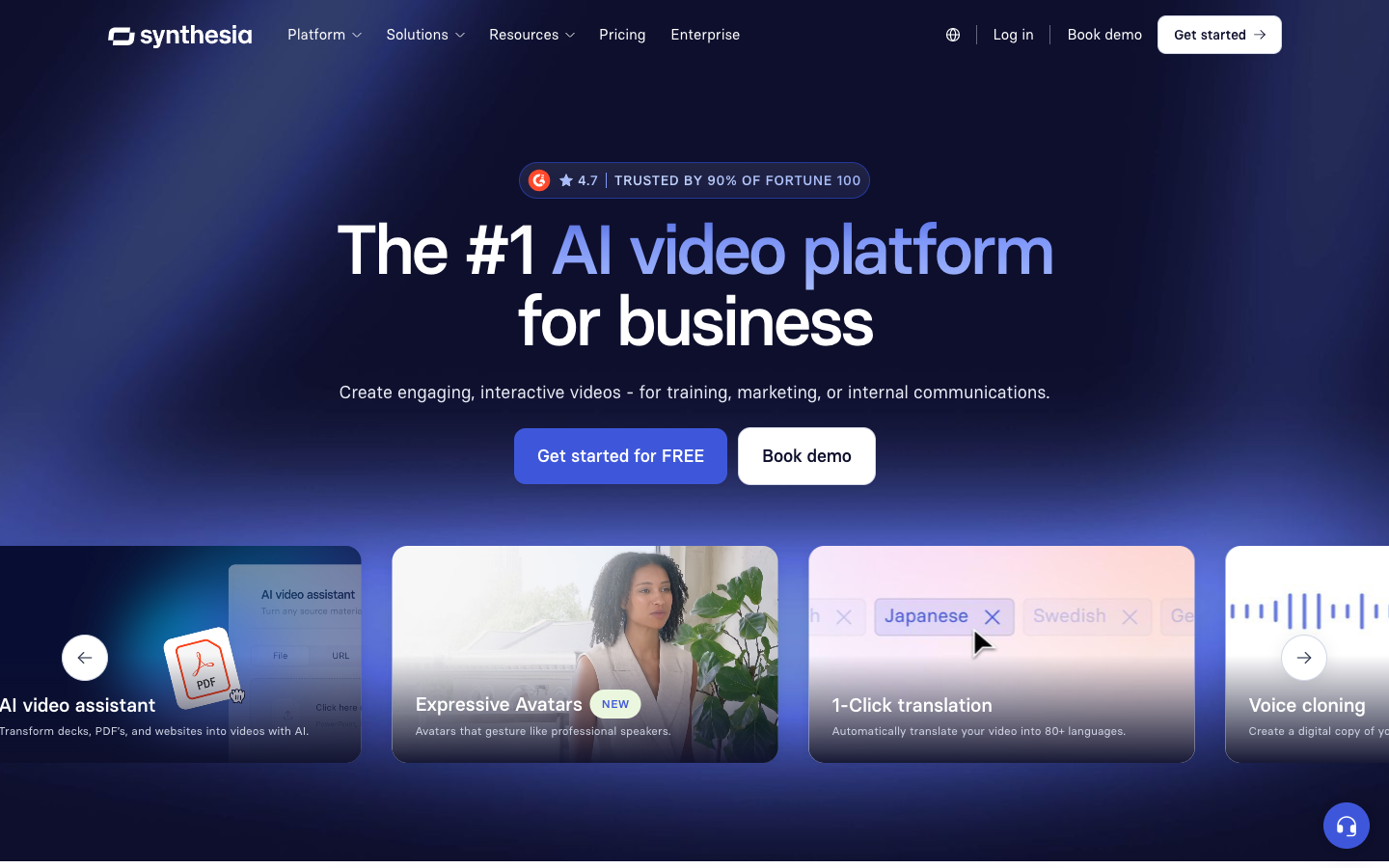
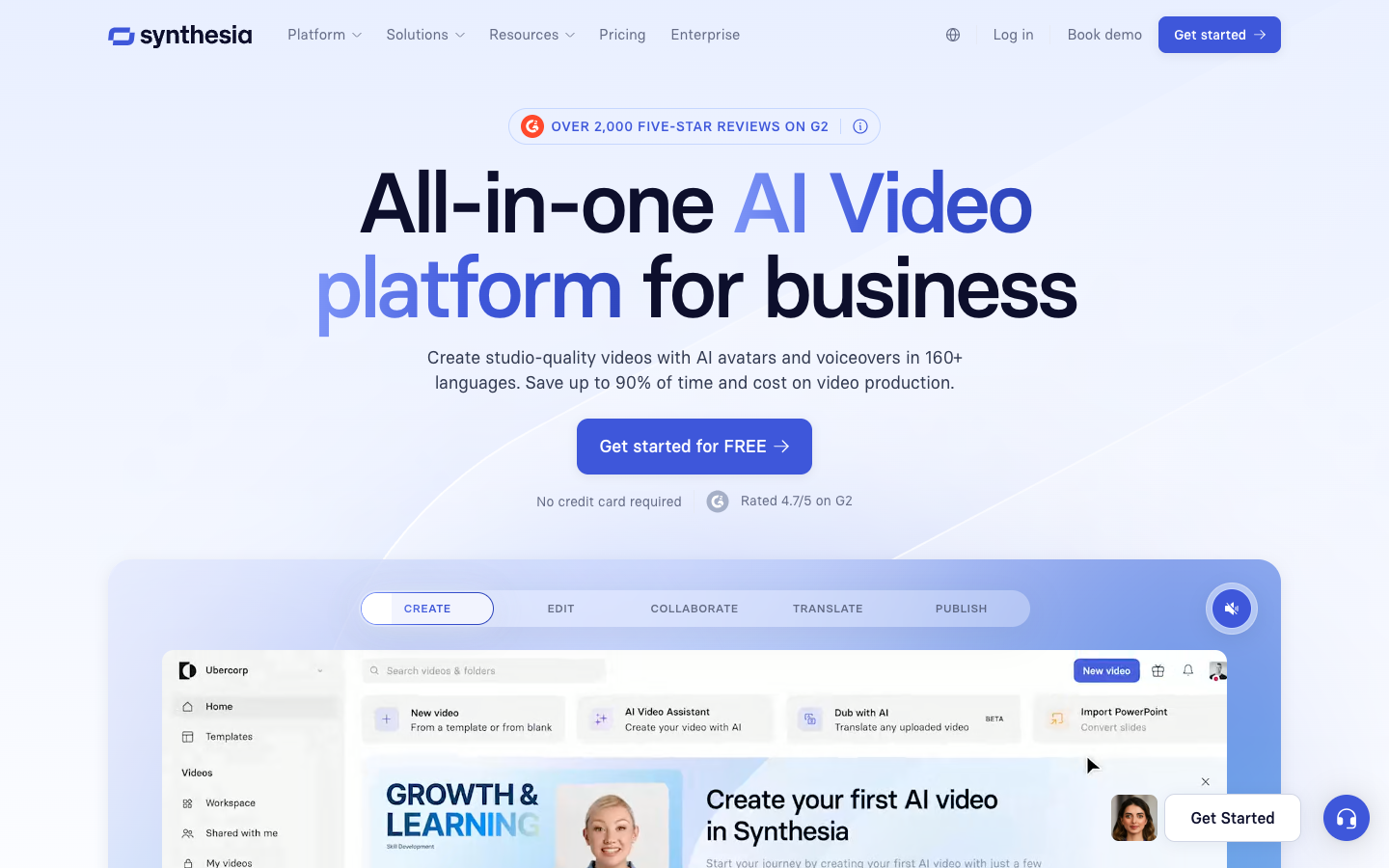
- HeyGen wins on avatar naturalness with 100+ avatars and 175+ languages. Synthesia wins on structured editing with 240+ avatars and 160+ languages. The feature gap has narrowed in 2026.
- Mid-market companies (50-5,000 employees) are underserved by both platforms, which optimize for either solo creators or Fortune 500 procurement cycles.
HeyGen and Synthesia are AI avatar video platforms that let teams create presenter-led videos without cameras or studios. HeyGen offers 100+ avatars across 175+ languages with more natural avatar movements. Synthesia offers 240+ avatars across 160+ languages with a more structured enterprise editor. Most HeyGen vs Synthesia comparisons frame the choice as “HeyGen for creators, Synthesia for enterprise.” That framing was already thin in 2024. In 2026, it’s incomplete: a 25-person training team will pay anywhere from $7,500 to over $25,000 per year depending on which platform and plan they choose, and neither has published HIPAA compliance documentation despite healthcare being one of the fastest-growing buyer segments. The actual HeyGen vs Synthesia decision depends on total cost of ownership, compliance gaps, and what breaks when your team grows past 10 users. If you’re evaluating AI avatar platforms for training or enablement, try Colossyan free before committing to either option. No credit card required.
The real HeyGen vs Synthesia question most comparisons miss
Most HeyGen vs Synthesia comparisons start with a feature table. Features are table stakes. The question that actually determines whether you’ll regret your choice 6 months from now is: what does this platform cost me over a full year, including the costs I can’t see on the pricing page?
Monthly subscription pricing tells you almost nothing about actual spend. HeyGen’s Business plan costs $149/month for the primary seat, but every additional team member adds $20/month. Synthesia’s Enterprise tier bundles more features but requires annual contracts with custom per-seat pricing that compounds as you add content creators across departments. The gap between sticker price and actual spend grows with every seat you add and every integration you need.
Here’s what goes into a real cost-of-ownership calculation for AI avatar video platforms:
- Base subscription cost (monthly or annual commitment)
- Per-seat fees for additional team members
- Integration costs (API access, LMS connectors, SSO setup)
- Content update costs (re-rendering time when scripts change)
- Localization costs (additional charges per language on some tiers)
- Training and onboarding time for new users
Mid-market training teams often choose HeyGen based on its lower Creator plan pricing ($29/month), then discover the Business plan ($149/month) is required for collaboration features. Synthesia avoids the tier-jump surprise but recovers margin through per-seat enterprise pricing that scales linearly with headcount.
The rest of this HeyGen vs Synthesia comparison covers features, pricing, compliance, and scale. But keep the total-cost lens on throughout.
HeyGen vs Synthesia features: what actually matters in 2026
Both platforms have expanded since 2024.
Avatar quality and naturalness
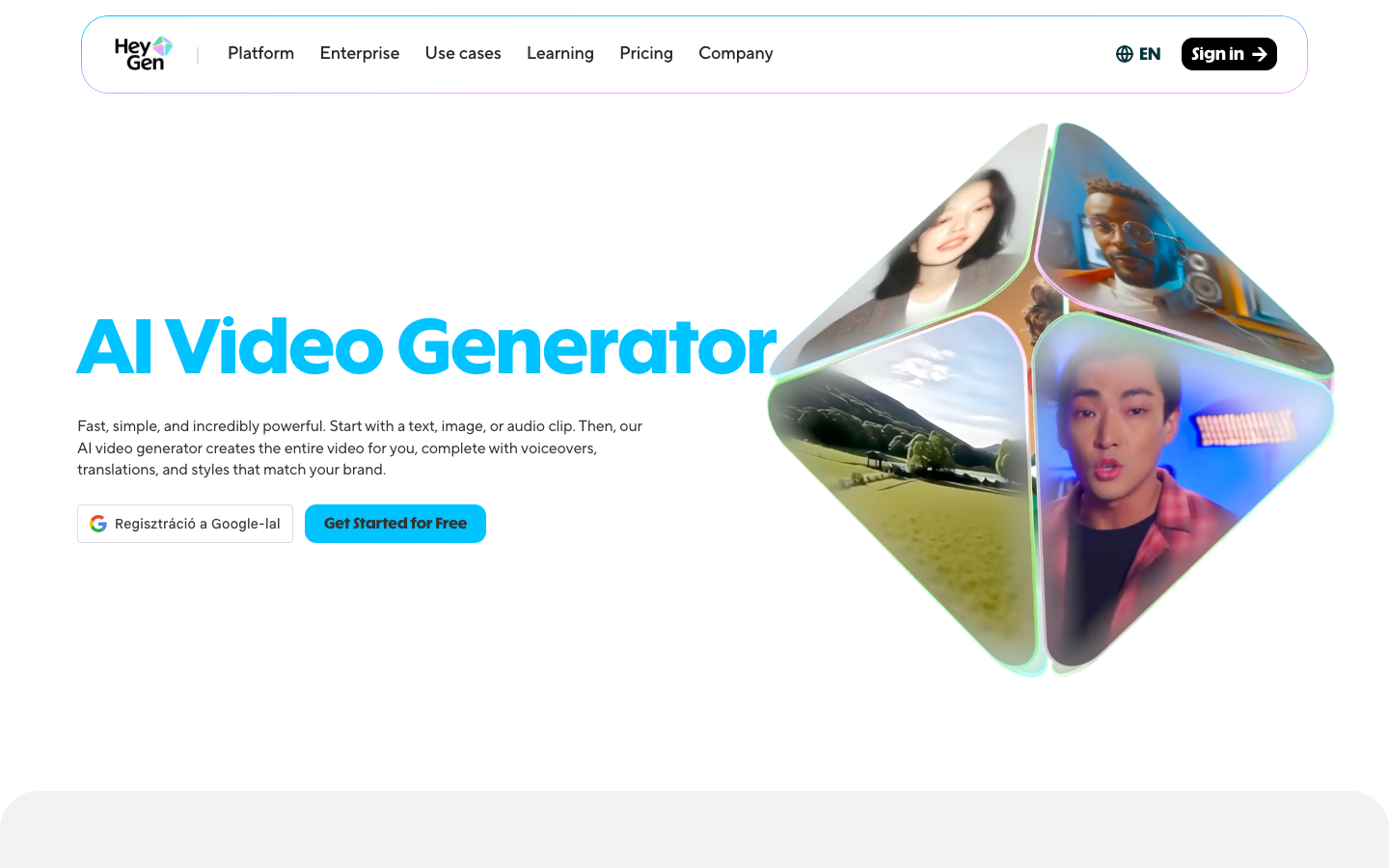
Reviewers consistently describe HeyGen’s avatars as more expressive, with more natural head tilts, micro-expressions, and gestures compared to Synthesia’s equivalents. Multiple third-party reviews note that HeyGen produces more lifelike presenter videos for short-form content, while Synthesia’s avatars maintain better consistency across longer videos. For training modules running 10-15 minutes, Synthesia’s stability matters more than HeyGen’s expressiveness. For short clips under 3 minutes, HeyGen’s naturalness stands out. Your average video length determines which platform looks better in production.
Language and localization
Both platforms offer strong multilingual support, though the coverage differs. HeyGen supports 175+ languages and dialects on paid plans (30+ on the free tier). Synthesia supports 160+ languages for narration. If your organization operates across Asia, Africa, or Eastern Europe, both platforms provide broad coverage. User reviews report that lip-sync quality varies by language on both platforms, with some users noting HeyGen glitches on tonal languages like Mandarin and Vietnamese.
Editing and content updates
Both platforms let you edit scripts and regenerate video without reshooting. Synthesia’s editor is more structured, with slide-based layouts that feel familiar to PowerPoint users. HeyGen’s editor gives more flexibility but less guidance, which means faster work for experienced users and more confusion for new ones.
Neither platform offers a batch find-and-replace function. If a regulatory change requires updating terminology across 50 training videos, you’re editing each one individually on both platforms. For teams managing fewer than 20 videos, this is manageable. Past that threshold, the manual update process becomes the bottleneck regardless of whether you chose HeyGen or Synthesia.
Quick feature comparison
| Feature | HeyGen | Synthesia |
|---|---|---|
| AI avatars | 100+ | 240+ |
| Languages | 175+ | 160+ |
| Custom avatars | Yes (paid tiers) | Yes (Enterprise) |
| SCORM export | Yes (Business+) | Yes (Enterprise) |
| Quizzes / branching | Yes (Business+) | Yes (Enterprise) |
| API access | Yes | Yes (Enterprise) |
| SSO | Enterprise only | Enterprise only |
| Free tier | 3 videos/month | 10 min/month, 9 avatars |
Both platforms now offer SCORM export and interactivity features on their higher-tier plans. This is a significant change from 2024 when neither had native SCORM support. However, both implementations bolt interactivity onto a video-first workflow. The HeyGen vs Synthesia interactivity comparison matters less than the question of whether bolted-on interactivity is enough for your training workflows, or whether you need a platform designed around course authoring from the ground up.
HeyGen vs Synthesia pricing: what you’ll actually pay
The sticker prices are misleading on both sides. HeyGen’s per-seat Business plan reaches $7,500+/year for a 25-person team before add-ons. Synthesia’s custom Enterprise pricing is not published, but user reports suggest much higher costs at the same team size. The HeyGen vs Synthesia pricing gap depends heavily on team size and which tier you actually need.
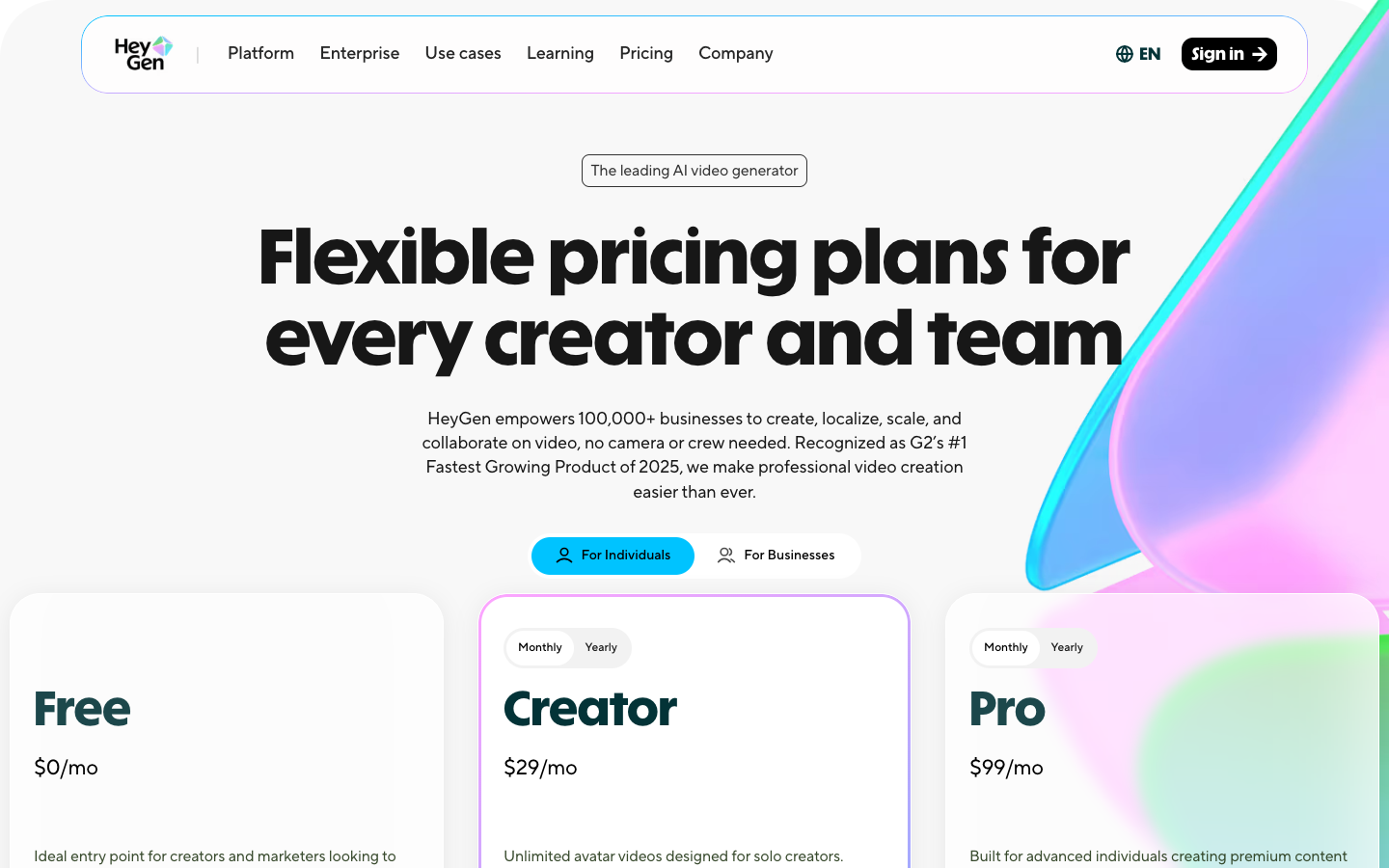
HeyGen pricing (verified March 2026):
- Free: 3 videos/month, limited features
- Creator: $29/month (monthly) or $24/month (billed annually). Designed for individual users.
- Business: $149/month + $20/month per additional seat. Adds collaboration, SCORM, interactivity, priority rendering.
- Enterprise: Custom pricing.
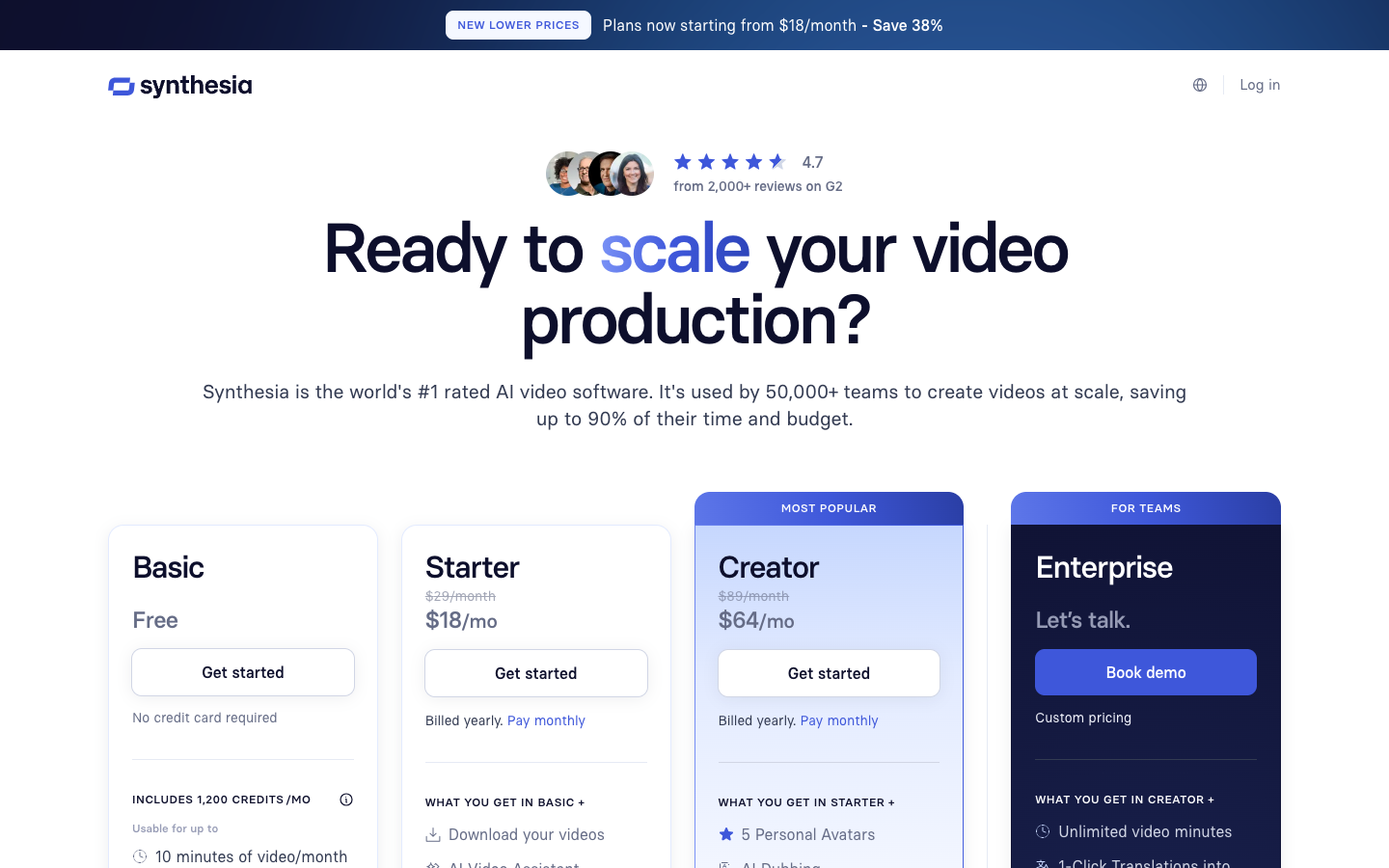
Synthesia pricing (verified March 2026):
- Free: $0/month, 10 minutes of video, 9 avatars
- Starter: $29/month (monthly) or $22/month (billed annually). Individual use.
- Creator: $89/month (monthly) or $67/month (billed annually). More minutes, more avatars.
- Enterprise: Custom pricing with per-seat costs. Not published.
12-month cost comparison for a 25-person training team
| Cost factor | HeyGen (Business) | Synthesia (Enterprise) |
|---|---|---|
| Base annual cost (1 seat) | $1,788/year ($149/mo) | Custom (not published) |
| Additional seats (24) | $5,760/year ($20/seat/mo) | Custom per-seat pricing |
| SCORM export | Included | Included |
| SSO / security | Enterprise only | Included on Enterprise |
| Estimated 12-month total | ~$7,548+ | Estimated $15,000-25,000+ (based on user reports) |
At the 25-person team level, HeyGen’s published pricing is lower. The HeyGen vs Synthesia breakeven depends on which Enterprise features you need from Synthesia (SSO, advanced brand kits, dedicated support). Synthesia’s Enterprise pricing is not public, so the estimate above is based on Reddit discussions and third-party reviews, not confirmed quotes. Neither platform is priced transparently for the 15-30 user range where most mid-market training teams land.
What the HeyGen vs Synthesia pricing pages don’t tell you: the hidden cost of re-rendering. Every script edit on both platforms consumes rendering resources. If your team updates content frequently (monthly compliance updates, quarterly product changes), ask your sales rep about rendering limits and speed before signing anything.
Compliance and security in the HeyGen vs Synthesia comparison
Healthcare and financial services buyers searching for HIPAA-compliant avatar platforms will find a gap in the HeyGen vs Synthesia comparison: neither platform has published HIPAA compliance documentation on their own security pages as of March 2026. Both hold SOC 2 Type II and GDPR certifications (Synthesia adds ISO 27001 and ISO 42001). None of that addresses data residency. Both platforms route video processing through multi-region cloud infrastructure, which means organizations that need data to stay within specific jurisdictions have a problem neither vendor’s security page acknowledges.
The missing BAAs are the headline problem in any HeyGen vs Synthesia evaluation for healthcare buyers. Training videos that reference patient workflows or medication protocols likely contain PHI, and no amount of encryption fixes the regulatory exposure of processing PHI on a platform without a signed Business Associate Agreement.
Regulated industries beyond healthcare face the same challenge from different angles. Financial services teams need FINRA content retention and SEC archival compliance that SOC 2 doesn’t cover. Government contractors need FedRAMP or ITAR authorization that neither vendor has published. “We take security seriously” on a marketing page is not a compliance certification.
For organizations with data residency requirements, Colossyan holds SOC 2 Type II certification, supports SSO, and offers configurable data residency for enterprise deployments. If your organization operates in a regulated industry, ask all vendors for explicit compliance documentation before any evaluation proceeds.
How Paramount creates training videos 10x faster
Paramount replaced manual video production with Colossyan's AI avatars, cutting production time from weeks to hours across their global training team.
Read the full story →What happens when your HeyGen vs Synthesia team scales past 10 users
Collaboration, governance, and content management challenges surface once a team grows past 10 users. The HeyGen vs Synthesia scaling question is less about video quality and more about what happens when 25 people across three departments share the same account.
HeyGen was built for individual creators and small teams. Collaboration features exist but feel bolted on. There’s no native approval workflow, no content library with role-based access, and no way to enforce brand guidelines across users. When a marketing team and a training team share the same HeyGen account, there’s no guardrail preventing someone from using the wrong avatar, the wrong intro template, or an outdated brand voice. A 5-person team can fix brand inconsistencies with a quick Slack message. A 50-person team spread across time zones faces governance chaos.
On the Synthesia side of the HeyGen vs Synthesia comparison, bigger investments went into enterprise features. Workspaces, team management, and brand kits give administrators more control. The structured editor enforces consistent layouts. But Synthesia’s enterprise features come exclusively on enterprise pricing, which means mid-market companies (50-500 employees) face a choice: pay enterprise rates for features they need, or stay on lower tiers without the governance tools that prevent content sprawl.
For organizations between 200 and 5,000 employees, the scaling pain points tend to cluster around three areas. The first is content governance: who can publish, who approves, and what happens to someone’s videos when they leave the company. The second is update management: when a policy changes and 50 training modules need new language, how does that happen without one person editing each video manually? The third is analytics. Basic view counts aren’t enough. Training teams need to know which specific employees watched which videos, and whether they completed any assessments tied to that content.
HeyGen addresses governance and analytics partially on Business and Enterprise plans. Synthesia covers governance more thoroughly on enterprise plans. Neither platform provides the depth of content lifecycle management, versioning, or assessment tracking that purpose-built training platforms offer.
Where HeyGen and Synthesia fall short for training content
Both HeyGen and Synthesia started as video creation tools and added training features over time. The video-first origin shapes every product decision they make. Both now offer SCORM export and basic interactivity on higher tiers. The HeyGen vs Synthesia comparison on training features is closer than it was in 2024, but the gap isn’t between these two platforms. The gap is between video tools with training features bolted on and platforms designed around the training workflow from the start.
What training teams need goes beyond creating and exporting a video. The full workflow includes course authoring, structuring content into modules, adding branching scenarios and assessments, tracking completions through an LMS, and maintaining content as policies and products change. Both HeyGen and Synthesia cover the first step (video creation) and now partially cover the second (SCORM export). Everything after that requires additional tools. For a deeper look at how AI is changing this workflow, see our guide on AI training video generators.
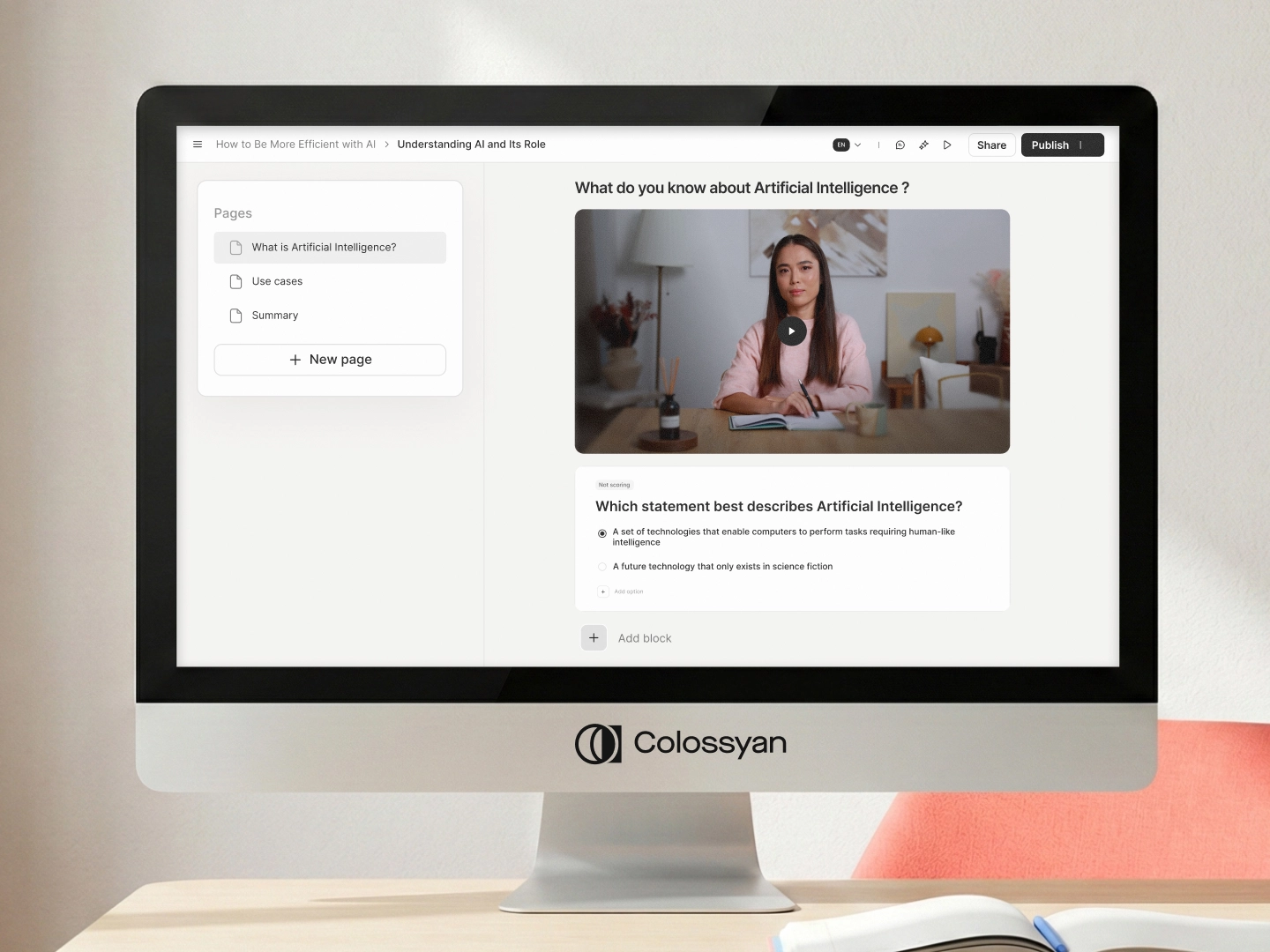
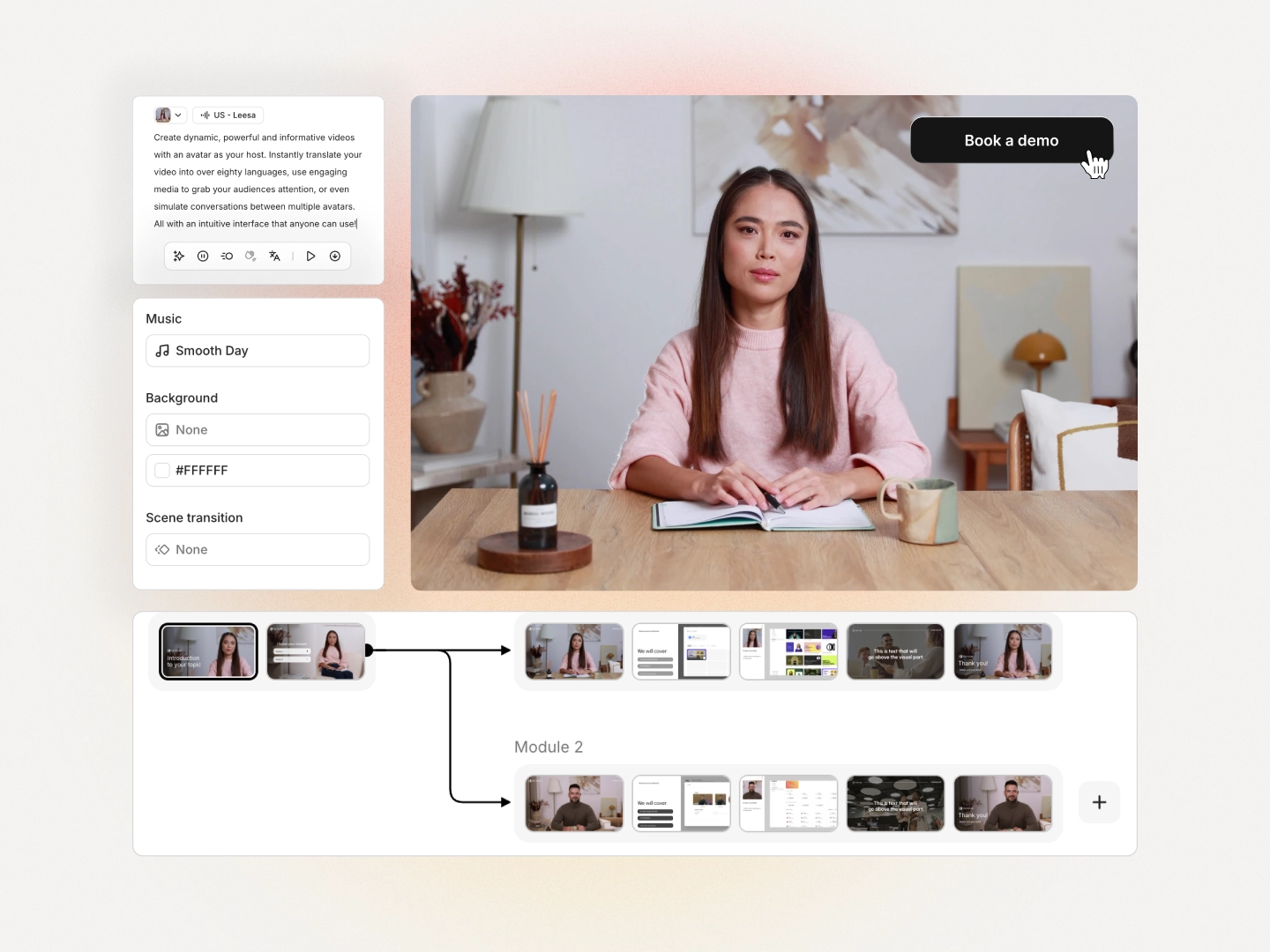
Colossyan was built differently. As an AI platform for training and enablement, Colossyan includes full course authoring with branching scenarios and quizzes, SCORM and xAPI export for LMS integration, and content lifecycle management that lets teams edit, version, and localize training materials without rebuilding from scratch. The difference is architectural: Colossyan treats video as one component of a course, not as the finished product.
“The biggest benefit of Colossyan is being able to have training material that never goes obsolete,” according to Magesh Sarma, CIO at AmeriSave. That maintenance capability is what separates a training platform from a video tool. Creating a video is a one-time cost. Keeping 200 training videos current across 15 languages is an ongoing operational challenge that only compounds as the content library grows.
Teams at Paramount, Ericsson, Continental, Cisco, Johnson & Johnson, and UPS use Colossyan daily. Rated 4.6 on G2 with 480+ reviews. For teams comparing HeyGen vs Synthesia and finding that neither fully covers their training workflow, see current pricing for detailed plans and feature breakdowns.